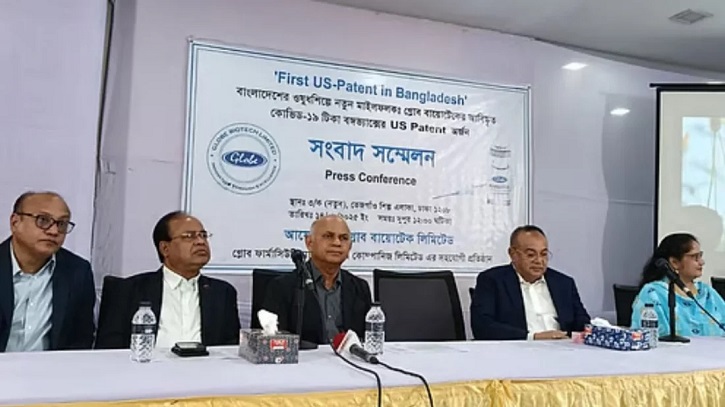
Globe Biotech Limited has achieved a historic milestone in Bangladesh’s research and pharmaceutical industry by securing a United States patent for its ribonucleic acid (RNA)-based COVID-19 vaccine, Bongovax. This marks the first time in the country’s 54 years of independence that a pharmaceutical innovation has been granted a patent.
The announcement was made at a press conference on Sunday by the company’s chief scientist, Dr. Kakon Nag. Globe Biotech, a subsidiary of Globe Pharmaceutical Group, has been engaged in gene-based therapies and advanced drug development for complex diseases since 2015. During the COVID-19 pandemic, a team led by Dr. Nag and Dr. Nazneen Sultana developed Bongovax.
In 2020, the vaccine’s genetic coding sequence was published in the United States National Center for Biotechnology Information (NCBI). The innovation was later highlighted in scientific publications, including a report in the renowned British journal Nature and research papers in Elsevier’s Vaccine journal. That same year, the World Health Organization (WHO) listed Bongovax among its registered COVID-19 vaccines.
According to Globe Biotech, Bongovax is the world’s only single-dose mRNA vaccine proven effective against multiple variants of the coronavirus. The company has applied its proprietary nanotechnology platform, which can also be used to develop DNA, subunit, inactivated virus, or recombinant virus-based vaccines.
The patent covers 30 innovative claims approved by the US Patent and Trademark Office. Globe Biotech stressed that this recognition establishes Bongovax as a novel, original invention at the global level.
The vaccine has already undergone successful animal trials in monkeys, marking the first such trial for a vaccine in Bangladesh’s history. It has also received approval from the Bangladesh Medical Research Council (BMRC) and the Directorate General of Drug Administration (DGDA) for human trials.
Experts say the patent will play a crucial role in Bangladesh’s preparedness for the Fourth Industrial Revolution and strengthen national health security. With this platform technology, the country can produce safe and effective vaccines domestically at lower costs, reduce dependence on imports, and explore export opportunities to earn significant foreign exchange.
Officials further noted that the innovation will help Bangladesh tackle the challenges of its graduation from Least Developed Country (LDC) status in 2026. Beyond COVID-19, the technology holds potential applications in developing treatments for cancer, diabetes, autoimmune diseases, blood disorders, and other complex conditions.
Dr. Kakon Nag described the achievement as not merely a vaccine patent but an international recognition of Bangladesh’s technological capabilities. “The next step is to complete final trials and bring this vaccine into the hands of the people,” he said.