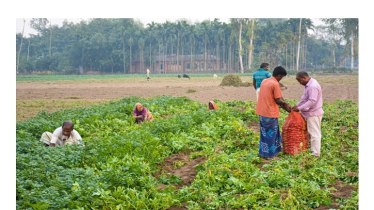
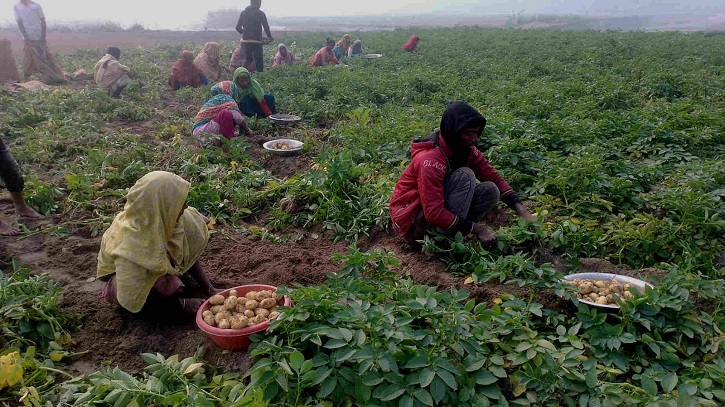
KISHORGANJ, NILPHAMARI – What began as a season of hope for the potato farmers of Kishorganj Upazila has turned into a financial nightmare. Despite a bumper harvest, a sharp decline in market prices has left growers unable to cover even their basic labor costs, let alone their total production investment. Known for supplying the country’s earliest varieties of potatoes, Kishorganj farmers usually enjoy high profit margins. However, this year, the situation has taken a grim turn. Farmers report that they were forced to sell their produce for as little as Tk 6 to Tk 8 per kg earlier this week—the lowest price recorded in four years.
"Potato farming has become a noose around our necks," said Kohinur, a farmer from Nayankhal village, who sold his crop at Taraganj market for Tk 6 per kg. "The losses are massive. I can't even recover the cost of the laborers who harvested the field." Another farmer, Dulal from Bahagili Union, shared a similar plight, noting that after losing nearly Tk 4 lakh this season, he is considering quitting potato cultivation altogether. He expressed the impossible dilemma many face: the cost of harvesting is now higher than the value of the crop itself.
According to the Upazila Agriculture Office, potato cultivation exceeded expectations this year, covering 6,660 hectares of land. While the weather was favorable, a combination of market oversupply, significant quantities of old stock remaining in cold storage, and rising costs for fertilizers and labor has created a perfect storm for local growers.
By Friday, there was a minor recovery in the market as prices rose to approximately Tk 13.50 per kg, triggering a rush among farmers to harvest their remaining crops. However, even at this improved rate, many farmers claim they will still face a net loss. "I sold my potatoes at Tk 13.50 today," said Hamidul, a farmer from Ismail village. "But even then, it doesn’t cover the Tk 35,000–40,000 per bigha we spent on cultivation."
Upazila Agriculture Officer Lokman Alam acknowledged the crisis but expressed optimism for the coming weeks. He explained that the price drop was caused by the sudden surge in supply and existing cold storage stocks, but noted a slight upward trend in prices. While officials hope farmers will eventually see some profit as the market stabilizes, the farmers of Nilphamari remains on edge, struggling to recover from one of the toughest seasons in recent memory.