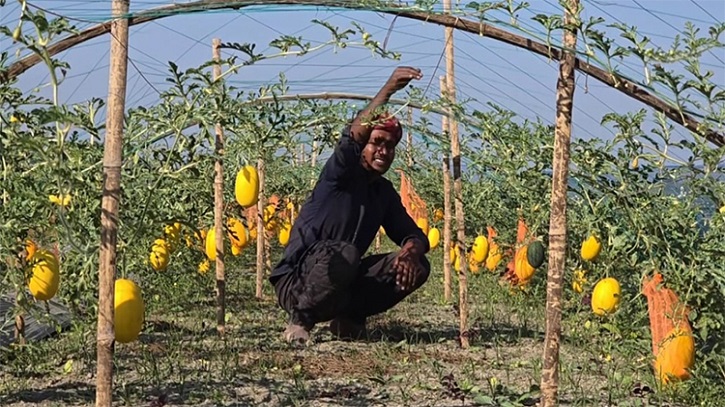
After achieving success in cultivating maize and groundnuts, Suman Mia has now found success in growing yellow watermelon in the char areas of Bhuapur upazila along the Jamuna River in Tangail.
The char areas of Gabsara’s Faldapara erosion-prone zone in Bhuapur were once largely uncultivated, where farming was considered highly risky. Farmers traditionally grew groundnuts, maize, or harmful tobacco crops, with few other viable options. Defying these long-held assumptions, Suman Mia, a 28-year-old degree student of Bhuapur Government Ibrahim Khan College, achieved success by cultivating watermelon for the first time on his own initiative after learning the techniques through YouTube.
Local farmers believe that if watermelon cultivation can be formally promoted by the government in the Jamuna riverine char areas and farmers receive incentives, it would allow multiple uses of the same land, significantly increase farmers’ income, and contribute to meeting the country’s growing demand for watermelon.
According to the Department of Agricultural Extension, farmers have independently cultivated three varieties of watermelon on four hectares of char land this year across Bhuapur, Nagarpur, Kalihati, and Tangail Sadar upazilas. With lower production costs and higher returns, the char lands are now covered with green vines. Due to favorable market prices and relatively low investment, interest in off-season watermelon cultivation is increasing among farmers in the district.
Speaking about his experience, Suman Mia said he became inspired after watching videos of watermelon cultivation on YouTube. Encouraged by what he saw, he decided to conduct a trial and leased five bighas of land. He began cultivating yellow watermelon for the first time this year through personal initiative. He planted Tripti, Modhumala, and Pakiza varieties across the land. A total of around 5,000 watermelon plants have produced fruit in his fields. Tripti and Modhumala watermelons typically have yellow outer skin, while the Pakiza variety has a green exterior. All varieties have bright red flesh inside and are known for their sweet taste and good quality.
Suman said his total investment amounted to approximately Tk 600,000. From the five bighas of land, he expects to earn a profit of around Tk 500,000. He noted that watermelon is primarily a winter crop and produces harvestable fruit within just three months. The fruits in his field have already grown well, and harvesting of these chemical-free watermelons is expected to begin within the next week. Each watermelon weighs an average of five to seven kilograms.
At present, people from surrounding areas are visiting Suman Mia’s fields to see the yellow watermelons. He said many have expressed interest in cultivating this crop in the future. Due to high yields and comparatively low costs, a growing number of farmers in the region are becoming interested in watermelon cultivation. Suman also expressed his intention to expand watermelon farming commercially on a larger scale in the coming years.
He added that the sandy soil of Bhuapur’s char areas is opening new possibilities for farmers through watermelon cultivation. With proper planning and institutional support, he believes this initiative could contribute to economic growth in the char regions. He noted that at least 10 farmers who previously cultivated risky tobacco crops have expressed interest in growing watermelon next year after seeing his success. He emphasized that government training and incentives would enable char-area farmers to achieve sustainable success in watermelon farming.
Bhuapur Upazila Agriculture Officer Mokhlesur Rahman said that Golden Crown is a relatively new watermelon variety cultivated in Bangladesh and is typically grown off-season. The fruit is smaller in size, has a yellow outer skin, and red flesh inside. It is tasty, nutritious, and yields abundantly. As an off-season crop, it commands a good market price. He said progressive farmers have begun cultivating this variety through demonstrations and personal initiatives.
He added that farmers are benefiting financially by cultivating watermelon at relatively low cost. To encourage wider adoption of this variety, the agriculture office is providing continuous monitoring and advisory support so that farmers can expand cultivation on a larger scale in the future.