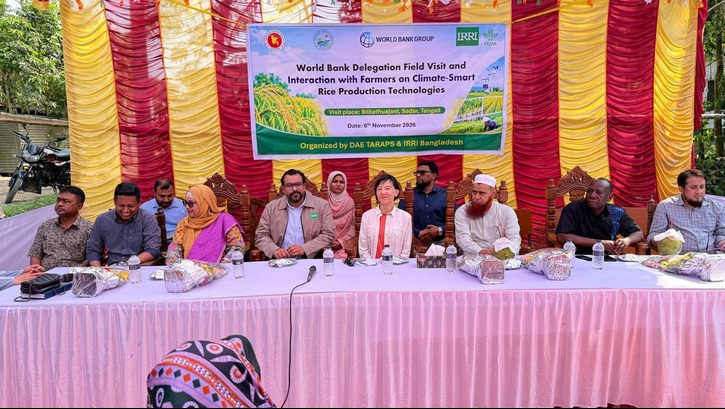
Tangail, 6 November 2026: A high-level delegation from the World Bank, the Department of Agricultural Extension (DAE), and the International Rice Research Institute (IRRI) visited field-level activities under the Technical Assistance for Re-structuring Agricultural Public Support for Transitioning to a Sustainable Food System in Bangladesh (TARAPS) Project in the Tangail Cluster on Friday to assess progress in promoting climate-smart rice production technologies and strengthening community-based seed systems.
The visit provided an opportunity for the delegation to observe ongoing field demonstrations, interact directly with farmers, and assess the practical application of improved rice production technologies, alongside initiatives promoting women's participation in local seed production.
The World Bank delegation was led by Ms. Ashoka Okumura, TARAPS Task Team Leader, and Ms. Samina Yasmin, Co-Task Team Leader, accompanied by consultants Mr. Boniface Okello Akuku and Mr. Naibur Rahman.
Representing DAE were Dr. Mohammad Rakibuzzaman Khan, Component Director, TARAPS Project; Abu Mohammad Enayet Ullah, Climate Smart Specialist, TARAPS Project; Mohammad Ashek Parvez from DAE Headquarters; and Rumana Akter, Upazila Agriculture Officer, Tangail Sadar.
The IRRI Bangladesh team included Dr. Muhammad Ashraful Habib, Lead Specialist – Seed System and Product Management; Dr. Sharif Ahmed, Postdoctoral Fellow – Agri-Food Systems; and Dr. Saidul Islam, Consultant – Seed System and Product Management.
Field Demonstrations Showcase Climate-Smart Rice Technologies
During the visit, the delegation observed several technology trials and demonstrations, including Triadic Comparison of Technologies (TRICOT), Urea Deep Placement (UDP), Wet Direct-Seeded Rice (Wet DSR), and Dealer-Customer Demonstrations.
These interventions aim to promote resource-efficient and climate-smart rice production practices while enabling farmers to evaluate their performance under local farming conditions.
Through the TRICOT approach, farmers compare different rice varieties and production technologies based on their own field observations and experiences. UDP promotes efficient fertilizer use and nutrient management, while Wet DSR offers an alternative to conventional transplanted rice cultivation, with opportunities to reduce labour and time requirements.
The Dealer-Customer Demonstration approach also engages local agricultural input dealers and their farmer customers in promoting improved technologies, strengthening local knowledge-sharing networks and facilitating wider technology adoption.
Farmers’ Voices at the Centre of Technology Adoption
The delegation interacted with participating farmers to understand their experiences, observations, and perspectives on the promoted technologies. Farmers shared practical insights into the benefits, implementation challenges, and opportunities for wider adoption.
The discussions highlighted the importance of connecting research-based innovations with effective agricultural extension services and farmers’ practical needs to ensure that technologies are locally relevant, accessible, and sustainable.
Women Farmers Strengthen Community-Based Seed Systems
A significant highlight of the visit was the interaction with women members of community-based seed production groups established in the Tangail area with technical support from IRRI Bangladesh.
The women farmers shared their experiences in seed production, the training and technical knowledge they had received, and the opportunities and challenges associated with producing and supplying quality seeds at the community level.
The delegation discussed the importance of strengthening local seed production capacity, improving access to quality rice seeds, and expanding the role of organized farmer groups in sustainable seed supply systems.
The initiative recognizes women’s important contribution to local seed systems while creating opportunities to enhance their technical capacities, participation, and roles in agricultural development.
Strengthening Partnerships for Sustainable Agricultural Transformation
The joint field visit reaffirmed the importance of collaboration among development partners, research institutions, and agricultural extension services in accelerating the adoption of climate-smart agricultural technologies in Bangladesh.
Through the TARAPS Project, the Government of Bangladesh, with support from the World Bank and technical contributions from IRRI, is working to promote improved agricultural practices, efficient resource management, climate-resilient rice production, and sustainable seed systems.
The visit also provided an important opportunity to review field-level implementation, listen to farmers’ perspectives, and identify opportunities to further strengthen technology dissemination and adoption.
The collaborative efforts of the World Bank, DAE, and IRRI are expected to contribute to more productive, resilient, resource-efficient, and inclusive rice-based farming systems in Bangladesh, with farmers remaining at the centre of agricultural transformation.
About the TARAPS Project
The Technical Assistance for Re-structuring Agricultural Public Support for Transitioning to a Sustainable Food System in Bangladesh (TARAPS) Project supports the transformation of agricultural public support towards a more sustainable, climate-smart, and resilient food system in Bangladesh through collaboration with relevant institutions and development partners.