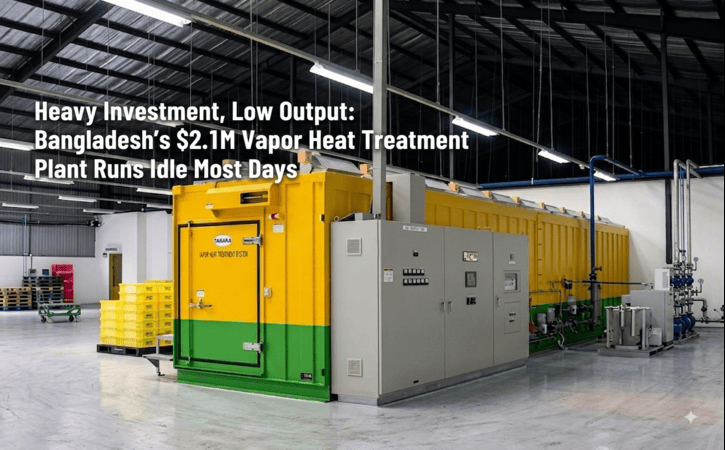
DHAKA: Launched with great fanfare just a month ago to boost agricultural exports, Bangladesh’s sole Vapor Heat Treatment (VHT) plant in Gabtoli, Dhaka, built at a cost of approximately BDT 25 crore ($2.1 million), is struggling to stay operational during the peak mango season.
During its inauguration, Agriculture, Fisheries, and Livestock Minister Mohammad Amin Ur Rashid proclaimed that the facility would spark a revolution in mango and agricultural exports. The plant boasts a processing capacity of 12 tons per day to eliminate invisible pests, eggs, and larvae from fruits. However, the reality on the ground is starkly different: the high-tech facility remains functional only one to two days a week.
At the inauguration, Minister Rashid expressed optimism regarding the plant's potential impact:
"Within a very short time, our mango exports will increase manifold compared to current levels—beyond what anyone can imagine."
Sweet mangoes from regions like Rajshahi face stringent quarantine and biosecurity regulations when entering international markets in Japan, Australia, or Europe. Although Bangladesh produces nearly 2.7 million tons of mangoes annually, export volume remains capped at a mere 3,100 tons due to the lack of international-standard sterilization infrastructure. The VHT plant in Gabtoli was introduced specifically to overcome this compliance hurdle.
Yet, just one month after opening, conveyor belts, steam chambers, and processing lines sit largely inactive at the height of the harvest season.
Farmers and exporters attribute the facility's underutilization to a fundamental flaw in site selection and planning. Placing the plant in Dhaka—roughly 300 kilometers away from the primary mango-producing belt—creates logistical barriers that compromise fruit quality.
Ismail Hossain Khan Shamim, an exporter and grower, highlighted the operational constraints:
"Managing the airport, quarantine procedures, and the VHT plant in separate locations creates significant operational friction. Vapor Heat Treatment requires freshly harvested mangoes that can be processed within hours of picking. Instead of building the plant in major orchard areas, it was set up in Gabtoli. We will hardly reap its benefits, rendering this a waste of public funds."
Agricultural export specialists agree that the facility should have been placed closer to primary cultivation hubs. Export Mango Specialist Arifur Rahman noted that planning failed to balance regulatory needs with consumer demand for freshness:
"Quarantine compliance and consumer demand must be aligned. To prioritize quality for end consumers, the facility should have been set up at a centralized hub near the orchards where multiple farm owners could easily access it."
When questioned about locating the plant hundreds of kilometers from key farming zones, Project Director Ruhul Amin indirectly acknowledged the structural oversight:
"When the initial plant was planned, it was viewed from a centralized national perspective so growers from Rajshahi, Satkhira, Rangpur, or the Hill Tracts could theoretically access it. That centralized perspective is likely why Dhaka was chosen for the first facility."
Despite possessing the necessary technology, the BDT 25 crore VHT plant remains largely stalled due to strategic misplacement and a lack of localized planning.