DHAKA: The government-promoted dwarf Vietnamese coconut trees, once distributed with massive hype across Bangladesh, have now turned into a nightmare for local farmers. A recent research report by the Bangladesh Agricultural Development Corporation (BADC) has revealed alarming data, showing that only 3% of these trees have successfully yielded fruit. Labeling the foreign variety a "silent killer" for the environment and underground water levels, the BADC has officially written to the Ministry of Agriculture seeking permission to cut down and remove these trees.
According to institutional sources, the dwarf variety was aggressively promoted under the "Year-Round Fruit Production for Nutrition Improvement Project." Enticed by the government's widespread campaign, thousands of farmers invested heavily in these saplings, only to face devastating losses. Currently, there are over 1 million such trees planted across the country.
The BADC’s internal study conducted across 42 state-owned farms paints a grim picture. Out of more than 5,000 Vietnamese coconut trees planted in these facilities, only 9% managed to flower. Ultimately, just 144 trees successfully retained fruit—representing a mere 3% success rate. Government officials themselves are now in a fix, as the trees failed to produce any significant yield despite strict adherence to the intensive care guidelines provided by the Department of Agricultural Extension (DAE).
Speaking on the issue, Shah Alam, Deputy Assistant Director of the Gazipur Horticulture Center, stated, "These trees are not yielding coconuts. Instead, they have imported new diseases and pests that are now infecting our native, local coconut trees." He added that these non-performing Vietnamese trees are currently occupying 45 acres of valuable land across 42 government farms. He emphasized the urgent need to uproot them and replace the space with other productive fruit-bearing trees.
The BADC has formally sent a letter to the Secretary of the Ministry of Agriculture requesting authorization for the immediate removal of these trees—a copy of which has been obtained by Agri24.tv.
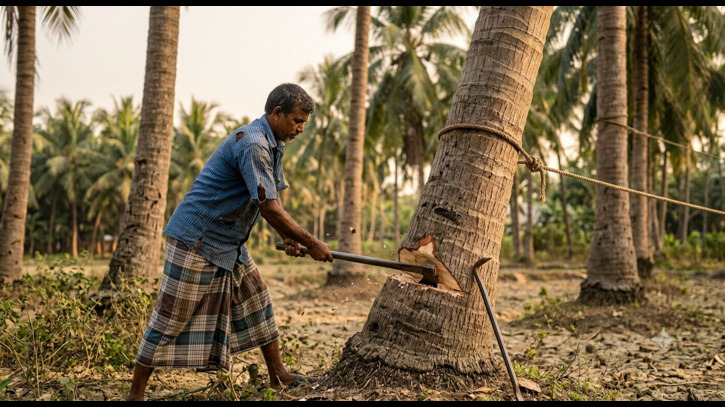
Devastated farmers report that even when a few trees produce green coconuts (dab) after massive financial investment and round-the-clock care, the fruits fail to mature properly. Furthermore, the foreign variety has introduced aggressive pests and mites, causing severe damage to surrounding native coconut plantations. Out of sheer frustration and mounting financial losses, many farmers, including Selim Reza from Natore, have already chopped down hundreds of Vietnamese coconut trees in their orchards.
Dr. Nazrul Islam, former Director General of the Bangladesh Agricultural Research Institute (BARI), strongly criticized the project, stating, "Bringing this foreign variety into the country without proper environmental suitability assessment or commercial trials was a massive blunder. It acts as a silent killer for our local environment and depletes groundwater levels rapidly."
However, Mehedi Masood, the former director of the project, defended the initiative, claiming that the lack of output is not a fault of the breed but rather a result of improper management and a failure to ensure adequate water supply.
Despite conflicting claims, considering the severe ecological risks and the continuous financial losses borne by the farming community, the BADC has firmly decided on the complete removal of these trees. Meanwhile, serious questions are being raised within agricultural and policy circles as to whose interest and under whose gross negligence this hazardous variety was imposed on Bangladeshi farmers without any prior feasibility studies.