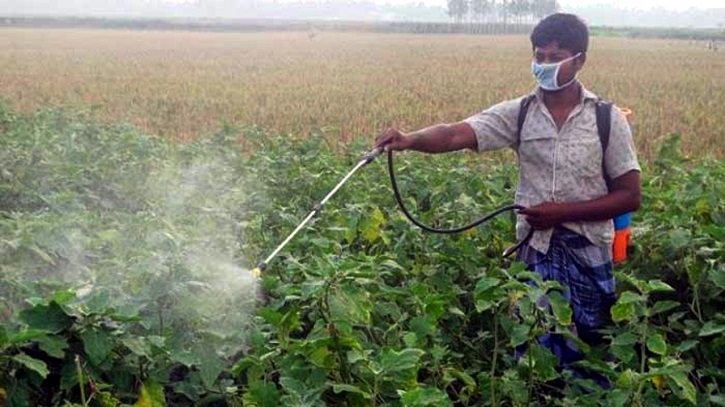
Agricultural lands in Madhabpur upazila of Habiganj have become filled with early winter vegetables, but the lush green fields are increasingly under threat from the unregulated use of chemical pesticides. Farmers, aiming to protect their crops from pests and diseases, are applying pesticides extensively—often without any expert guidance or official consultation. From tomato and eggplant fields to bean, cauliflower, and paddy crops, the same pattern can be observed across the upazila.
According to local sources, farmers are spraying various chemical pesticides both in the morning and afternoon, relying heavily on them to keep their produce safe. However, most farmers admit they use these chemicals based purely on assumption, without any official list or knowledge of what substances they are applying.
In villages under Chaumuhani, Bahara, Jagdishpur, Shahjahanpur, and Chatiaingh Dhamraghar, as well as Bulla and Baghasura unions, small-scale vegetable growers were seen applying pesticides throughout their fields. When asked about the dosage, most said they use pesticides based on observation or advice from neighboring farmers, not from agricultural experts.
A vegetable grower from Bahara village said, “We just know that this kills insects. We use it as others do.” Another farmer from Chaumuhani, Md. Shafik Mia, explained that he used to apply pesticides once or twice a year, but now does so every week in hopes of better yields—something that, he noted, has already changed the soil’s color.
Assistant Professor Kabir Hossain from the Department of Environmental Science at a local degree college warned that excessive use of chemical pesticides destroys the soil’s biodiversity. “Earthworms, fungi, and bacteria are the living components that keep soil fertile. When these organisms die due to chemicals, the soil loses its life, structure, and fertility. Over time, crop yields decline, and the land becomes barren. Prolonged use allows these toxins to seep into groundwater, eventually entering the human body,” he said.
Experts suggest that the growing dependency on pesticides can be reduced through several field-level initiatives: promoting organic pest control, encouraging mixed-crop farming, conserving beneficial insects that prey on harmful pests, and providing proper training to farmers. They emphasized that these four measures are now crucial for sustainable agriculture.
Maria Akter, a lecturer at Montola Shahjalal Government College, said, “Farmers must receive proper training to stop the excessive use of pesticides. They need to know which pesticides are approved and which are not. Farmers can also prepare natural pest repellents using neem leaves, ginger, garlic, and chili extracts—these are entirely organic and environmentally friendly.”
Agriculture officer Sajib Sarkar stated that farmer training programs are already being conducted but need to be made mandatory. “The agriculture office provides lists of approved pesticides, and no one should use chemicals beyond that list,” he added.
Health officer Imrul Hasan Jahangir warned that these chemical toxins have direct and long-term impacts on human health. “Toxins from vegetables accumulate in the body and damage vital organs such as the kidneys, liver, and nervous system. Continuous exposure increases the risk of chronic illnesses, including cancer,” he said.