
Dhaka: Rice is the synonym of food security and the cultural identity of Bangladesh, while playing a significant role in stabilising the economy and politics. The irrigated rice field is one of the primary sources of methane emission from the agricultural sector. Throughout the growing season, the irrigated rice field maintains a water depth of 10-15 cm. While methane ranks second in absorbing heat from the environment, rice ecology releases the highest amount. This is why it is essential to minimise the emissions of this gas by encouraging rice farmers. But it's hard to convince them that more water doesn't mean more rice yield, which is unscientific. However, farmers can be convinced if they receive rewards in exchange for carbon credits, which is a global mechanism designed to compensate them while reducing GHG emissions by minimising water waste. The International Fund for Agricultural Development (IFAD) may simplify entry to the carbon credit opportunity through its Reducing Agricultural Methane Programme (RAMP).
Carbon credit mechanisms Bangladesh is progressing towards global carbon credit mechanisms through organisations like the Clean Development Mechanism (CDM) under the Kyoto Protocol and the Joint Credit Mechanism (JCM) with Japan. Accordingly, Bangladesh has so far registered 21 projects under the Clean Development Mechanism (CDM).
Of these, 12 projects have already reduced over 19 million tonnes of CO₂-equivalent. Bangladesh has earned USD 17 million by 2023 and has the potential to reduce an additional unspecified number of tonnes of CO₂-equivalent. The key projects included home systems, improved cookstoves, brick kiln efficiency improvements, and gas leakage reduction initiatives.
Bangladesh collaborates with Japan through the Joint Crediting Mechanism (JCM), which provides 50% grant support. The ongoing projects include high-efficiency chillers, solar-diesel hybrid systems, efficient looms in weaving factories, and the expansion of the power grid. These initiatives are expected to reduce carbon dioxide equivalent emissions by 0.2 million tonnes annually.
Currently, the carbon-credit activities focus on sectors other than agriculture. But agriculture sectors such as rice and livestock, and even aquaculture, are major sources of methane and nitrous oxide.
AWD and Smart Fertiliser Use: Alternate Wetting and Drying (AWD) irrigation can reduce global warming potential (GWP) by about 36%, while Urea Deep Placement (UDP) reduces emissions by 21% compared to conventional fertiliser use.
The most effective way to reduce methane is to grow rice following AWD technology instead of growing under continuous irrigated conditions. In an AWD culture, the paddy has been allowed to dry up to the field capacity level, which facilitates the reduction of methane production by 30–50%. Not only AWD but also urea deep placement (UDP) matters. According to BRRI scientists, AWD can reduce global warming potential (GWP) by 2.08 tonnes CO₂eq per hectare compared to "Continuous Flooding", which has a carbon credit value of approximately 48 USD per hectare (based on 22.2 USD). GWP is a method for comparing how much heat different greenhouse gases trap in the atmosphere over a specific time, usually 100 years, relative to CO₂: CH₄ x 28; N₂O x 300. Considering the total irrigated rice area of 4.8 million hectares in Bangladesh, the total claimable carbon credit could reach nearly 214 million USD.
In terms of fertiliser management, UDP is more efficient and reduces greenhouse gas emissions by about 0.83 tonnes CO₂eq per hectare compared to the application of prilled urea, which is valued at around 19 USD per hectare. If the total rice area of 11.6 million hectares in Bangladesh can be brought under UDP practice, the total claimable amount would be 221 million USD from the international carbon credit market. Most rice-growing areas of Bangladesh face significant challenges in implementing such a technology. If the technology could be scaled up to a certain percentage of the total rice areas, it would yield a significant benefit, both economically as well as environmentally. Thus, the simultaneous application of AWD and UDP is expected to reduce a greater amount of GWP to reward the additive benefit: lowering methane emissions and creating substantial opportunities for Bangladesh to benefit from the international carbon credit market.
Enteric fermentation, an invincible metabolic activity of livestock and their manure, is the source of methane and nitrous oxide.These GHGs can be reduced through improved feed management, better grazing, and keeping low-emission breeds. Anaerobic digesters, composting, covered storage, slurry acidification, efficient land application, and nutrient management are some practices good for mitigating methane and nitrous oxide emissions. Smart management and the MRV-ETF system can align the reduced methane with the carbon credit mechanism.
The Role of IFAD’s RAMP: The Reducing Agricultural Methane (RAMP) initiative, guided by the International Fund (IFAD), can be supportive to the farmers who have limited access to carbon markets by providing financial support, technical assistance, and policy guidance.
The programme can endorse climate-smart agriculture practices, including AWD irrigation and UDP, as well as other relevant practices for livestock and aquaculture, while also strengthening MRV systems in collaboration with partners such as BRRI, DAE, BLRI, DoF, and FRI to certify emission reductions. By training farmers, RAMP can lower certification costs while building capacity through extension networks. Additionally, the program aligns methane mitigation through national agricultural strategies and NDC commitments, considering RAMP is a key driver of the carbon finance mechanism in Bangladesh.
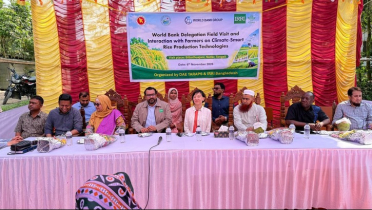
Challenges on the Ground:There are many socio-economic barriers that discourage farmers from accepting AWD. Additionally, farmers are completely unfamiliar with the certification process for carbon credits. Initially, this practice appears to be costly. Yet these can be overcome. Method and result demonstrations, farmer field schools, and co-financing schemes can build confidence among the farmers. Partnerships with BADC, BMDA and some GO-NGOs might bridge the knowledge gaps. With IFAD’s support, Bangladesh can align science, policy, and markets.
In conclusion, Bangladesh has an opportunity to link climate-smart agriculture with financial benefits for its farmers from the world's carbon credit market. IFAD’s RAMP initiative might play a transformative role for the benefit of smallholder farmers who have limited access to knowledge and finance. By financing technologies such as AWD irrigation, improving fertiliser efficiency, and strengthening MRV systems, RAMP ensures reliable discharge reductions that can be traded as carbon credits. Farmer cooperatives and training are expected to further reduce costs and boost acceptance. By implementing mitigation strategies into policy and practice, RAMP positions Bangladesh’s farmers not only as sponsors to food security but also as active partakers in global climate solutions.
Jiban Krishna Biswas is a Senior Technical Consultant (Reducing Agricultural Methane Programme, Asia and the Pacific Division) of International Fund for Agricultural Develoment