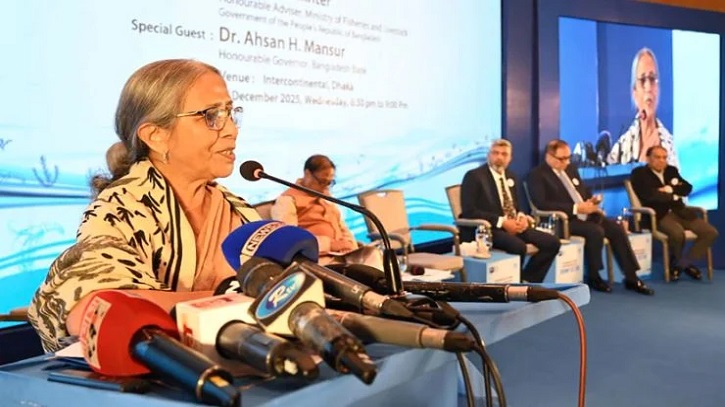
At a national policy dialogue in Dhaka, Fisheries and Livestock Adviser Farida Akhter urged all stakeholders to stop clearing mangrove forests to expand shrimp farms, warning that the coastal environment cannot be protected without preserving these critical ecosystems. She made the call while addressing the event titled “Transforming Policy Support for Reviving Bangladesh’s Shrimp Sector,” jointly organized by the Bangladesh Frozen Foods Exporters Association (BFFEA) and Policy Research Institute of Bangladesh (PRI) at Hotel InterContinental.
The adviser noted that allegations such as the use of jelly in shrimp and other malpractices have severely affected Bangladesh’s image abroad, leading to shrinking export markets and significant national losses. Emphasizing the importance of accurate field-level data, she said that effective policymaking is impossible without understanding ground realities.
Expressing deep concern over marine fish stocks, Farida Akhter stated that illegal, unregulated, and excessive fishing had caused a 78 percent decline in fish reserves over the past seven years, calling the situation alarming. She added that climate change and pollution are emerging as major threats to the sector.
Addressing the issue of electricity bill disparity, she said that food-producing sectors such as fisheries and livestock are forced to pay power tariffs similar to industrial sectors, which she termed an inequity. She noted that efforts had been ongoing for a year to resolve this issue and expressed hope that a 20 percent reduction in electricity bills would be approved soon.
Sharing updates on financial reforms, the adviser said that a proposal for establishing a specialized Fisheries and Livestock Bank had been submitted to the Bangladesh Bank governor. She added that with improved technology, enhanced skills, and environmentally responsible aquaculture practices, Bangladesh’s fisheries sector could achieve greater growth.
Farida Akhter reiterated the necessity of recognizing fisheries and livestock as a complete and independent sector rather than treating it as a sub-sector. She said progress had been made in resolving inter-ministerial disparities.
Bangladesh Bank Governor Ahsan H. Mansur, speaking as a special guest, noted that financing alone cannot solve the challenges of the sector. He said low productivity remains a core issue and urged genuine entrepreneurs to come forward.
Speakers at the event observed that although shrimp was a major export sector in the 1990s, it has now fallen behind. They called for incentives similar to those provided to industries, including a 20 percent rebate on electricity bills, cash support, and the creation of a dedicated fund to revive the sector.
The event was presided over by BFFEA President Md. Shahjahan Chowdhury. Senior Vice-President Md. Tarikul Islam Zahir delivered the opening remarks, while the keynote paper was presented by PRI Research Director Dr. Bazlul Haque Khondker. Following the discussions, Simark (BD) Ltd Chairman and Managing Director Md. Iqbal Ahmed presented a summary of the dialogue.