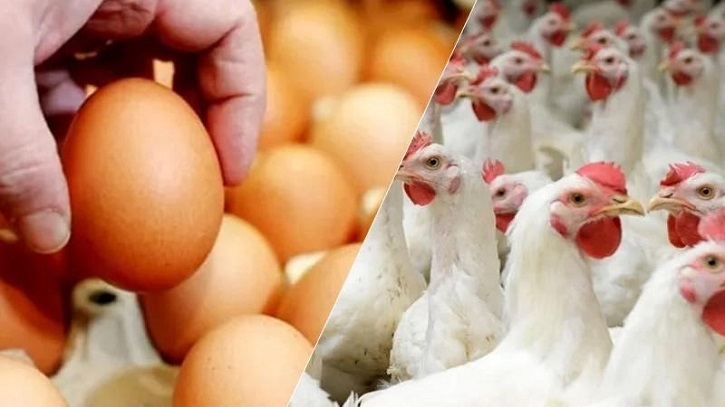
Bangladesh’s poultry industry has fallen into deep crisis following a sustained decline in egg and chicken prices for more than a year. From marginal farmers to feed mills, breeder farms, pharmaceutical suppliers, and marketing networks, the entire value chain has slowed significantly. Unable to absorb prolonged losses, many farms are shutting down, leading to reduced production. Industry stakeholders warn that if the situation continues, sustaining the poultry sector will become increasingly difficult.
Despite rising production costs, prices have continued to fall, placing layer farmers under the most severe pressure. According to the Department of Agricultural Marketing, the officially determined price of eggs is 10.58 taka at the farm level, 11.01 taka at wholesale, and 11.87 taka at retail, while the production cost per egg has been calculated at 10.19 taka. However, eggs are currently being sold at an average of 7.87 taka per piece at the farm level in Dhaka, Gazipur, and surrounding areas. Although retail prices in the capital are slightly higher, they remain between 8.80 and 9 taka per egg. As a result, farmers are incurring losses of between 2 and 2.30 taka per egg. According to the Department of Livestock Services, daily egg production stands at approximately 55 million pieces, translating into monthly losses of around 30 to 34.8 billion taka for farmers nationwide.
Similar price declines have been observed in the broiler and sonali chicken markets. Government-set farm-level prices place broiler chicken at 168.91 taka per kilogram, while current market prices range between 110 and 122 taka. This results in a loss of nearly 47 taka per kilogram for farmers. In the case of sonali chicken, losses exceed 50 taka per kilogram.
Unable to withstand these losses, many farmers are being forced to sell chickens before they reach their optimal production period. This has increased financial losses and disrupted production cycles. While farm-level egg prices have fallen to as low as 7.50 taka, the same eggs are selling in retail markets for 9 to 10 taka. This means farmers are losing between 20 and 26 taka per dozen eggs, while intermediaries are earning profits of 20 to 24 taka per dozen. A similar pattern exists in the broiler market, where farmers lose 45 to 47 taka per kilogram, while intermediaries earn profits exceeding 40 taka. Regardless of market conditions, the burden of losses continues to fall almost entirely on farmers.
Poultry farmers say their distress is largely ignored. Md Iqbal Hossain Sohag, a farmer from Satbaria village in Sonagazi upazila of Feni, said the cost of producing each egg is nearly 9 taka, but he is forced to sell them at 7.50 taka. He is incurring daily losses of more than 22,000 taka, amounting to nearly 700,000 taka per month. He noted that egg prices usually remain strong during winter, but this year the trend has reversed. With Ramadan approaching, he fears prices will fall further. According to him, there appears to be no one willing to address these losses.
Another farmer from Saheber Hat area in the same upazila, Md Nurnabi, said feed and medicine prices are rising while disease outbreaks remain persistent. Meanwhile, egg prices remain far below production costs. Many farmers have already closed their farms, and others are struggling simply to survive.
In Kishoreganj’s Kuliarchar upazila, the poultry sector has been pushed to the brink by falling egg and chicken prices. Farmers Sharif from Purba Goboria village and Habibur Rahman from Paschim Goboria jointly invested nearly 10 million taka to establish a layer farm with 6,500 hens. They are now suffering daily losses, with total losses reaching at least 700,000 taka over the past two months.
As egg and chicken prices continue to decline, farmers are struggling to purchase feed and medicines regularly. Md Arsh Mia, general secretary of the Kuliarchar Poultry Dealers Association, said it has become difficult to supply feed to many farms, leaving feed and medicine traders in distress as well.
While the government has set a maximum retail price for eggs, no minimum price has been fixed. As a result, market monitoring intensifies when prices rise, but no effective measures are taken to protect farmers during price crashes. Price slumps persist for much of the year, followed by supply shortages that again destabilize the market.
Professor Dr Md Ilias Hossain of the Poultry Science Department at Bangladesh Agricultural University said that if eggs were allowed to be stored under a government-supported system similar to potatoes or onions, year-round market stability could be achieved.
The Bangladesh Poultry Industries Central Council has put forward a six-point proposal to address the crisis. These include setting minimum prices for eggs and poultry meat, providing subsidies during off-seasons, allowing egg storage in cold storage facilities, offering low-interest loans, and facilitating exports.
Farmers say they want fair prices and a stable market. Without these measures, farms will continue to close, and thousands of people will lose their livelihoods. Bangladesh Poultry Industries Central Council President Shamsul Arefin Khaled said that whenever egg or meat prices rise, all government monitoring agencies become active, but when prices fall, no effective action is taken to protect farmers. As a result, price declines persist for most of the year.
He added that in many countries, farmers receive subsidies during off-seasons to manage such situations, and surplus eggs are stored in cold storage facilities. None of these mechanisms currently exist in Bangladesh.
Director General of the Department of Livestock Services Dr Md Abu Sufian said egg and poultry prices fluctuate at different times of the year. He noted that egg demand has declined due to increased availability of vegetables. In winter, schools remain closed, reducing demand, while hotels and restaurants are also consuming fewer eggs. Additionally, the number of social events this winter has been lower than in previous years, further reducing demand and contributing to lower prices.
He said the department has prepared a strategic plan to protect farmers and has not allowed imports this year. Efforts are also underway to reduce production costs to support poultry farmers.