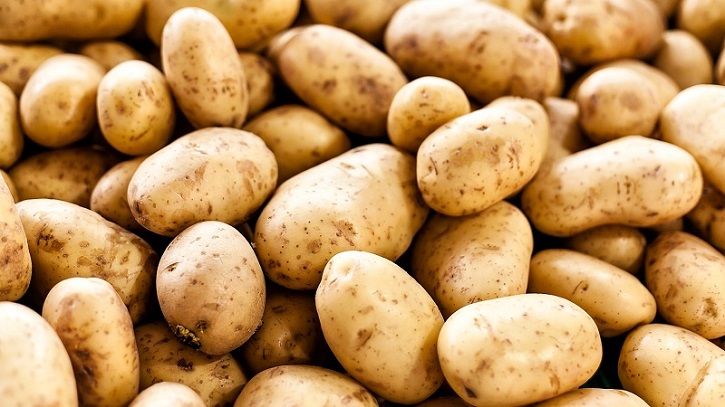
Farmers went to the fields with dreams. After purchasing fertilizer and seed potatoes at high prices, they produced a good harvest. But that very crop has now become a burden. There is no price in the market, and the potatoes are lying idle in cold storages. Retrieving the stored potatoes now requires paying additional money out of pocket. What was once stored in hopes of profit has turned into a source of distress. With new potatoes entering the market, prices of old potatoes have fallen further, with sales reported in some areas at as low as five to six taka per kilogram.
Market prices have dropped so sharply that selling potatoes no longer covers cold storage fees. Instead, farmers must pay an additional 20 taka per sack just to retrieve their stored produce. Calculating the losses, farmers and traders are refraining from collecting potatoes from cold storages. As repeated notices went unanswered, cold storage authorities in several areas announced via loudspeakers deadlines to remove potatoes by December 15. Even then, farmers did not respond.
Cold storage operators have warned that if potatoes are not removed within the next few days, refrigeration systems will be shut down and they will no longer take responsibility for the stored produce, though storage charges will still be collected. As current market prices make it impossible to recover storage costs through sales, farmers and traders are staying away. This has pushed farmers into financial hardship while placing cold storage owners in a difficult position.
Earlier, on December 12, the Ministry of Agriculture requested the Cold Storage Association to continue storing potatoes throughout December to help farmers recover losses. However, the announcement of forced removal through public notices and loudspeaker announcements created anger and confusion among growers.
Meanwhile, prices of seasonal vegetables have declined due to increased supply. With new potatoes flooding the market, demand for old potatoes has fallen to its lowest level. On Thursday, old potatoes were seen selling at 11 to 14 taka per kilogram in local markets. Traders said prices of old potatoes have dropped by around eight taka per kilogram over the past 20 to 25 days. As one trader put it, the arrival of new potatoes has delivered the final blow to old potatoes.
Unable to secure fair prices after factoring in production costs, transportation expenses, and storage fees, both farmers and traders are incurring losses. Potatoes stored in hopes of profit have become a liability for many. In some areas, farmers are feeding potatoes to cattle and goats, unable to absorb further losses.
According to the Department of Agricultural Extension, potatoes were cultivated on approximately 495,000 hectares of land in the 2024–25 fiscal year, producing more than 11.5 million tonnes. Annual domestic demand stands at around 8 million tonnes, with an additional 800,000 to 1 million tonnes required for seed purposes. This leaves an estimated surplus of 2.5 to 3 million tonnes, which has largely been stored in cold storages.
The Department of Agricultural Marketing reports that the country’s 384 cold storages can store around 3.3 million tonnes of potatoes, nearly all of which were filled last season. More than 1 million tonnes of this stock consist of seed potatoes. At present, there is no market price suitable for releasing such a large volume. In many cases, farmers must pay an additional 20 taka per sack to retrieve potatoes, discouraging them from collecting their produce.
Cold storage authorities in districts including Joypurhat, Rangpur, Thakurgaon, Rajshahi, and Munshiganj have issued notices urging farmers to remove potatoes. In some areas, they have announced plans to shut down refrigeration systems if potatoes are not removed by December 15.
Rezual Islam, a farmer from Begungram in Kalai upazila of Joypurhat, said he had stored 250 sacks of potatoes. He said selling them would not only fail to generate any income but would require paying an additional 20 taka per sack, which is why he has not gone to retrieve them.
Enamul Haque, assistant manager of a cold storage facility in Kalai, said around 20 percent of stored potatoes remain uncollected as farmers are not coming. He said shutting down the refrigeration system and removing the potatoes may become the only option.
The crisis has deepened further with the arrival of new potatoes in the market. Demand for old potatoes has fallen sharply, with prices dropping to five to six taka per kilogram in some areas, while new potatoes are selling at 20 to 21 taka per kilogram. This has also pushed early potato growers into losses.
Farmers and traders said the government’s announcement to purchase potatoes at 22 taka per kilogram has not been implemented in practice. In the absence of a formal notification, no purchases are taking place at the cold storage level, leaving the market unaffected by the announcement.
Bangladesh Cold Storage Association President Mostafa Azad Chowdhury said they are struggling with four to five hundred thousand tonnes of potatoes still stored. Although potatoes are usually withdrawn by November, many farmers did not do so this year.
Agriculture Secretary Mohammad Emdad Ullah Mian said farmers and traders typically withdraw potatoes by November. However, on November 18, the ministry requested cold storage owners to continue storage until December, to which they agreed.
Sector insiders said only 3 to 4 percent of domestically produced potatoes are used for purposes other than fresh consumption. In contrast, potatoes serve as a major industrial product in developed countries.
Research by the Chinese Academy of Agricultural Sciences shows that the United States processes 64.46 percent of its potato production, with large portions used for frozen French fries and fast food industries. Canada processes 68 percent, Germany 70 to 80 percent, Belgium 80 percent, China around 15 percent, and India 7 percent.
PRAN-RFL Group is marketing various potato-based products, including chips, in the domestic market. Its Director (Marketing), Kamruzzaman Kamal, said the processed potato food market is expanding but faces multiple challenges. He said not all potato varieties are suitable for all processed products, and issues related to proper variety selection, management, and storage persist. Improper storage at the farmer level often degrades potato quality.
Dr Md Mosharraf Hossain Mollah, chief scientific officer at the Tuber Crops Research Centre of the Bangladesh Agricultural Research Institute, said potatoes in Bangladesh have high water content and low dry matter, making commercial diversification costly. He said further research is required to make diversification profitable.
Agricultural economist Dr Jahangir Alam said the lack of diversified use leads to recurring crises over surplus potatoes every year. Less than 1 percent of total potato production is exported. Globally, trade in potato starch and flake-based products is growing at an average rate of 10 percent annually. He said both public and private investment are needed in this sector, along with farmer-level training on variety selection and proper storage to maintain quality.