Hurricane Melissa, the most powerful storm ever to strike Jamaica, made landfall on the island with catastrophic intensity. Packing sustained winds of 298 kilometers per hour and a central pressure of 892 hectopascals, Melissa now ranks among the most intense hurricanes ever recorded in the Atlantic basin.
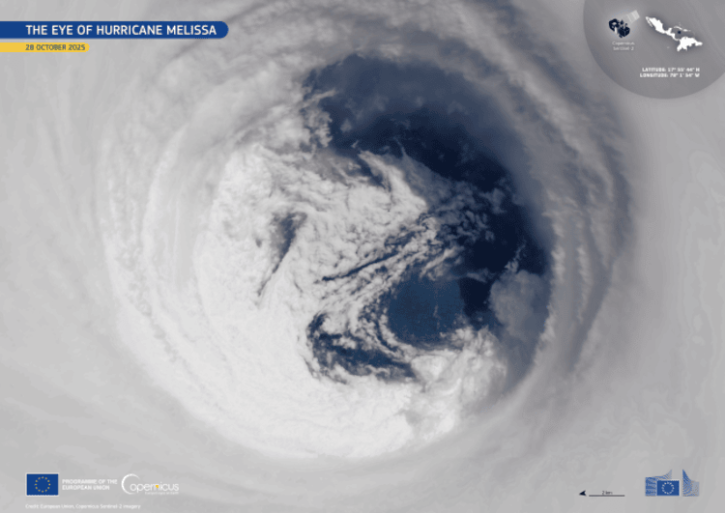
At 15:55 UTC on the day of landfall, one of the Copernicus Sentinel-2 satellites captured a striking image of Hurricane Melissa’s eye just hours before the storm slammed into Jamaica’s southern coast. The image revealed the storm’s perfectly defined eye and massive spiral cloud bands, underscoring its exceptional strength and organization.
High-resolution imagery from the Copernicus Sentinel-2 mission plays a vital role in crisis response, enabling rapid mapping, assessment of disaster impact, and coordination of relief operations. The data helps authorities and humanitarian agencies evaluate damage in real time and plan emergency interventions more effectively.
As rescue and relief efforts continue, authorities are relying on satellite data and on-the-ground assessments to gauge the full scale of destruction caused by the unprecedented storm.