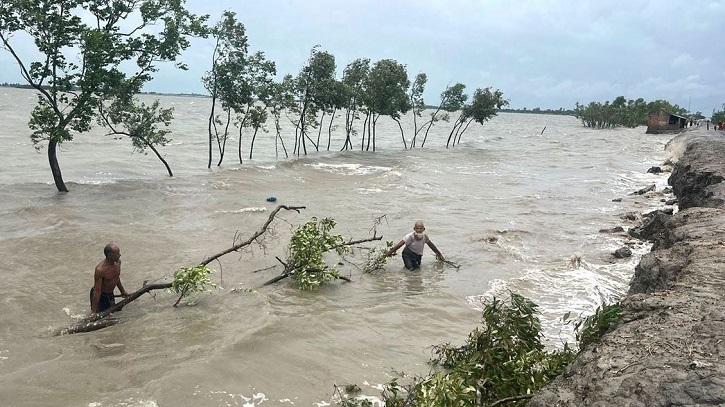
Climate change is intensifying natural disasters across Bangladesh, with the coastal regions facing the brunt of its impacts. Frequent storms, tidal surges, floods, river erosion, and landslides are now a recurring reality, leaving communities vulnerable and livelihoods under severe threat.
Farmers in the coastal belt continue to battle climate adversity to produce crops, while fishermen struggle to sustain their earnings as fish populations dwindle. Experts warn that the shifting coastline has become the most pressing challenge for millions living along the country’s shores.
Due to Bangladesh’s geographic position, melting Himalayan glaciers, upstream water flow, and heavy monsoon rainfall converge into the country’s major river systems—the Ganges, Brahmaputra, and Meghna—before emptying into the Bay of Bengal. Each year, around 1.5 million hectares of arable land are submerged by floods and waterlogging, steadily reducing cultivable land in the coastal belt. Adding to the crisis, reduced freshwater flow in the dry season allows seawater intrusion, salinizing fields and threatening agricultural output.
Bangladesh has a 711-kilometer-long coastline, including 125 kilometers around the Sundarbans and 155 kilometers along Cox’s Bazar. This stretch features expansive tidal floodplains and countless estuarine deltas, all of which remain highly unstable. Cyclones and tidal surges frequently damage embankments, allowing saline water to inundate lands permanently and worsening waterlogging.
Coastal rivers and farmland are increasingly suffering from salinity, while rising sea levels, glacier melt, and erratic rainfall further compound the crisis. Bangladesh now ranks among the most climate-vulnerable countries in the world, with its coastal regions standing at the forefront of risk. In recent years, many rivers have begun silting up, disrupting trade and economic activities in affected areas.
Professor Dr. Moniruzzaman of the Department of Geography and Environment at Jagannath University noted that seasonal patterns are shifting dramatically. “During the monsoon, we are experiencing excessive rainfall, while in the dry season, prolonged drought is becoming more common. Unseasonal heavy rains are damaging crops, forcing farmers not only to change crop varieties but also to contend with cyclones, rising salinity, and tidal surges that are disrupting production,” he said.
Meteorologists have echoed these concerns, stressing that climate shifts are endangering nature-dependent livelihoods. Reduced fish production is depriving freshwater, estuarine, and marine fishers of their main source of income, pushing many into uncertainty.
Dr. Syeda Israt Nazia, Chair of the Department of Geography and Environment at Jagannath University, said natural disasters in Bangladesh have grown both in frequency and severity. “Earlier, major cyclones would strike once in 10 or 15 years. Now, due to climate change, they are hitting almost every year. Coastal residents must remain prepared at all times. Together with erosion, siltation, and land transformation, these changes are driving millions of coastal people into hardship,” she said.
As rising seas, changing weather, and eroding land reshape Bangladesh’s coastline, the country’s coastal communities continue to face mounting uncertainty over their future.