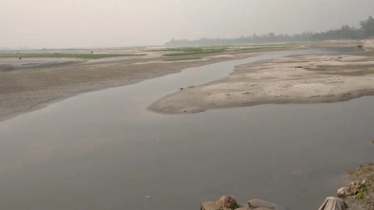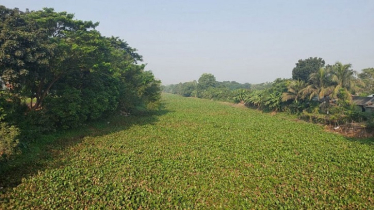

The once swift-flowing Teesta River has now receded, leaving behind expansive sandbars and newly emerged char land. Fertile with silt deposits from recent floods, these lands have become the foundation of renewed hope for farmers who lost their livelihoods during the monsoon. Across these chars, farmers are cultivating potatoes, pumpkins, bottle gourd, mustard, wheat, maize, peanuts, onions, garlic, chilies and a wide range of winter vegetables, sustaining their families through dry-season farming.
A recent visit to the Mahipur area of Gangachara upazila revealed that only 60 meters of the 850-meter bridge now carries water, while farmers cultivate vegetables across the exposed riverbed. In the char regions of Choto Rupai under Marnea Union and Salapakhali under Gozghonta Union, vast plots have been planted with sweet pumpkins. The rapidly spreading vines have already covered much of the sandy terrain. Farmers are practicing mixed cultivation by leaving space between pumpkin beds to sow onions, garlic, red spinach and bottle gourd.
On a winter afternoon in Choto Rupai, Halima Begum was tending her pumpkin field with her grandson. She has cultivated sweet pumpkin on two bighas of land. Halima explained that farming on char land is their only means of survival, and the family waits each year for the floodwater to recede so they can begin cultivation. She said that all family members contribute to farm labor throughout the season.
Another farmer, Abul Hossain, has planted sweet pumpkins on three bighas and shared that last year’s potato season brought losses. He hopes this season’s early pumpkin cultivation will bring better returns.
According to the Department of Agricultural Extension (DAE), approximately 8,000 hectares of land across 67 chars in Gangachara, Pirgacha and Kaunia upazilas are currently under cultivation. Each year these areas produce more than 125,000 tons of crops such as maize, wheat, peanuts, sesame, linseed, sweet pumpkin, bottle gourd, cauliflower, cabbage, radish, eggplant, bitter gourd, mustard, sunflower, carrot, onions, garlic and other vegetables, generating an estimated market value of nearly Tk 300 crore. In the three upazilas, sweet pumpkin alone is being cultivated on 300 hectares, while preparations for planting additional crops are underway. Water levels in the Teesta usually drop from late September, allowing planting to begin in October and November. After harvesting pumpkin, farmers shift to cultivating bottle gourd, with the final crops collected by March before the chars begin to submerge again in May and June.
In Mahipur near the Teesta Bridge, cultivation of winter crops is in full swing. Some farmers prepare sandy land for pumpkin cultivation by digging pits and filling them with silty topsoil and organic fertilizer, while others are irrigating young fields or sowing seeds of onions, garlic and vegetables.
Farmers say sweet pumpkin offers high profit at minimal cost. Nazirul Islam explained that each plant produces eight to ten pumpkins, weighing three to four kilograms each. At the beginning of the season, pumpkins sell at the field for Tk 15 to Tk 20 per kilogram, making char-grown sweet pumpkin one of the most profitable crops.
In Shankardaha char, Ahad Ali has cultivated onions and garlic on 80 decimals of land. He said the silt-rich soil yields excellent harvests, ensuring year-round household consumption and surplus produce for sale.
Farmers also noted that they can cultivate only during the dry season. The fertile silt makes cultivation easier and more productive, but challenges remain due to poor transportation infrastructure, which complicates marketing and distribution. Toward the end of the season, irrigation becomes difficult as river water levels fall.
Abdullah Al Hadi, chairman of Lakshmitari Union, stated that the Teesta’s monsoon current regularly floods the char areas and destroys crops, while erosion wipes out land and homesteads. Yet the re-emerging chars in the dry season act as a blessing for farmers, enabling them to sustain their livelihoods through seasonal farming. He emphasized that providing farmers with fertilizer, seeds, modern agricultural training and irrigation equipment would significantly boost productivity.
Gangachara Upazila Agriculture Officer Syed Shahinur Islam reported that this year’s target for sweet pumpkin cultivation is 160 hectares, of which 100 hectares have already been planted. Farmers are receiving seeds, fertilizer and technical guidance, and field-level support is ongoing.
Sirajul Islam, Deputy Director of the Department of Agricultural Extension in Rangpur, said the vast char lands of the Teesta have opened new economic opportunities. Sweet pumpkin from these chars is now being exported abroad. He added that modern farming methods are being promoted and that char crops generally require limited irrigation. The Bangladesh Agricultural Development Corporation has installed buried pipes for irrigation in some areas, while farmers in outlying zones are managing irrigation on their own.