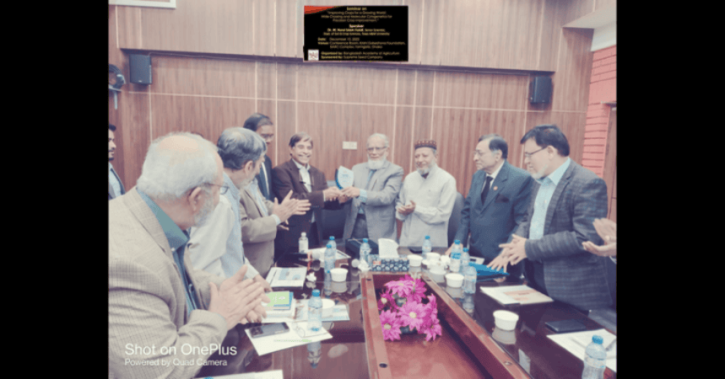
The Bangladesh Academy of Agriculture (BAAG) today hosted a high-level seminar focused on advanced crop improvement strategies aimed at strengthening national food security. The event took place at the conference room of the Krishi Gobeshona Foundation (KGF), bringing together researchers, scientists, and sector experts to discuss state-of-the-art innovations in crop breeding. The theme of the seminar was “Wide Crossing and Molecular Cytogenetics for Precision Crop Improvement.”
Dr. M. Nurul Islam Faridi, a senior scientist in the Department of Soil and Crop Sciences at Texas A&M University, United States, delivered the keynote presentation. The session was chaired by Professor Lutfor Rahman, President of BAAG.
During his address, Dr. Faridi underscored the transformative potential of precision crop improvement in ensuring sustainable food security. He elaborated on breakthrough breeding methodologies that enhance crop yield, nutrient content, and resistance to major diseases. According to him, strategic integration of two core approaches will shape the future of resilient crop development: wide hybridization, which introduces beneficial traits from wild relatives into domesticated crops through controlled breeding, and molecular cytogenetics, which enables the identification and positioning of targeted genes by examining chromosomes at the molecular level.
Presenting research findings from his laboratory, Dr. Faridi demonstrated how alien gene introgression has significantly improved yield potential and disease resistance in major crops such as wheat, maize, okra, and tomato. He highlighted several cutting-edge techniques used in precision breeding, including Fluorescence In Situ Hybridization (FISH), a method applied for accurate chromosomal mapping of genes and markers. He also discussed Chromosome Laser Capture Microdissection and Targeted Sequencing, two advanced approaches used to isolate and analyze specific chromosome regions in detail.
Dr. Faridi expressed his conviction that integrating chromosome biology with modern breeding frameworks can make crop improvement efforts more strategic, sustainable, and climate-resilient. Citing examples of superior okra and tomato lines developed in his U.S. laboratory, he conveyed strong interest in contributing to the enhancement of Bangladesh’s agricultural capacity. He emphasized his willingness to support Bangladeshi scientists through specialized training in advanced breeding tools and methodologies.
He further requested the Bangladesh Academy of Agriculture to identify young, dedicated, and promising researchers and encouraged them to send their résumés for skill development opportunities in his laboratory. The seminar was co-sponsored by Supreme Seed Company Limited.