In the fertile Gomti River basin of Comilla, known for its sandy loam soil, agriculture has been a way of life for generations. For over four decades, this land, nourished by water and the tireless labor of farmers, has been producing a wide range of vegetable seedlings. What began as a small-scale profession has now grown into a multimillion-taka industry. After facing severe losses from last year’s floods and erratic weather, seedling growers have made a strong comeback this year, nurturing renewed hope for the winter vegetable season. Among the leading areas, Samashpur village has made remarkable progress.
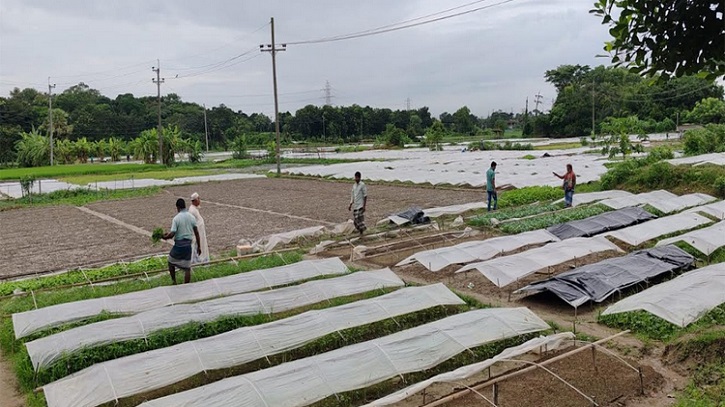
A recent visit to Samashpur in the Burichang upazila of Comilla revealed a scene of bustling activity from dawn. Farmers were seen preparing fields, watering seedbeds, and tying seedlings into bundles while wholesalers stood nearby counting and collecting them. Such scenes have become routine across this region.
According to the Department of Agricultural Extension (DAE), around 20 hectares of land in Comilla are currently dedicated to seedling production, involving more than 700 farmers. The sector has created direct and indirect employment for nearly 5,000 people. In addition to Samashpur, seedling production is also taking place in Daklapara, Kalakchua, Kabila, and Nimsar, while Chandina, Debidwar, Barura, and Chauddagram upazilas have also emerged as significant centers for seedling cultivation and trade.
District agricultural officials estimate the market value of seedlings produced in Comilla each season to be between 20 and 22 crore taka. The superior quality of these seedlings has earned them a strong reputation across the country. Seedlings of tomato, chili, cauliflower, cabbage, bottle gourd, pumpkin, and various other vegetables from this region are supplied to Chattogram, Noakhali, Feni, Chandpur, Brahmanbaria, Sylhet, Habiganj, Narayanganj, and Dhaka, among other districts.
Farmer Torab Ali from Hamalabari in Debidwar upazila said he suffered heavy losses due to last year’s floods. Determined to recover, he started preparing for vegetable cultivation early this season and came to Samashpur to collect seedlings. “Good-quality seedlings are always available here,” he said. “That’s why I come every year. I plan to begin cultivation soon with these healthy seedlings.”
Md. Jahangir Alam, owner of the well-known Sathi-Bithi Nursery in Samashpur, said his family has been in the seedling business for nearly four decades. “My father, Yusuf Ali, started seedling production here shortly after the British period,” he said. “When he encouraged others to join, the entire village gradually became involved. I have been in this profession for 40 years now. Samashpur’s reputation for quality seedlings has grown over generations. Because of their high standard, our seedlings are sold nationwide. From this area alone, seedlings worth about seven crore taka are sold each year.”
Md. Saiful Islam, owner of Madina Nursery, said the main production season runs from the Bangla months of Srabon to Kartik. “Last year, heavy rains and floods caused major losses,” he said. “This year, we’ve overcome those setbacks and resumed production and sales at full pace. Farmers are buying seedlings enthusiastically again.”
Burichang Upazila Agriculture Officer Afrina Akter said, “We regularly provide technical advice and support to farmers engaged in seedling production. To ensure both higher productivity and quality, we have been conducting training programs under the supervision of the upazila agriculture office. Although frequent rainfall initially posed some risk, we expect good results by the end of the season if weather conditions remain favorable.”
Comilla’s Deputy Director of the Department of Agricultural Extension, Mizanur Rahman, stated that the district remains one of the country’s leading regions in seedling production. “For years, local farmers have been producing quality vegetable seedlings that are supplied across Bangladesh,” he said. “We continue to support them with training, improved seed selection, pest management, and modern technology. Currently, more than 700 farmers are engaged in seedling production across 20 hectares of land. This season, we expect total trade in this sector to exceed 20 crore taka. The success of this seedling industry will play a vital role in enhancing national vegetable production. To sustain and expand this achievement, we are working to strengthen advanced training and capacity-building initiatives for growers.”