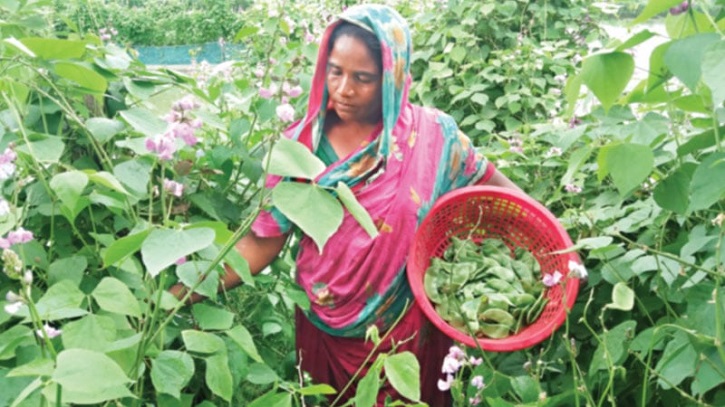
Aklima Begum, 40, once owned only a three-decimal homestead and carried the burden of supporting her speech-impaired husband and two children. In 2016, she leased 10 bighas of land for paddy cultivation and simultaneously built fish enclosures, planting beans along the embankments. That decision marked a turning point. Today, Aklima is a full-time farmer whose bean fields not only sustain her family but have also created livelihoods for others.
Residing in Angardah village under Kharnia Union of Dumuria in Khulna, Aklima shared that last year, her expenses for cultivating beans on one bigha of land amounted to Tk 300,000. After recovering her costs, she earned Tk 200,000 in profit. Since 2016, her income from beans has enabled her to build a permanent house, purchase furniture, a television, and a refrigerator, and even start a cattle farm.
Once dominated by fish farming, Dumuria’s vast wetlands are now witnessing a transformation as farmers turn to vegetable cultivation. Alongside shrimp farming, the commercial cultivation of beans, bottle gourd, and other vegetables has expanded rapidly. At least 226 villages in the upazila are now engaged in bean cultivation, generating an annual market worth Tk 1.7 billion. Thousands of women have taken direct roles in farming, significantly contributing to the rural economy.
According to the agriculture office, summer bean cultivation in Dumuria is followed immediately by the winter season, ensuring year-round production. Varieties such as BARI-3, Biscuit, Iret, NSC, Ruposhi Bangla, and Habib are being cultivated, with the red-flower BARI-3 variety proving most popular among farmers.
In 2024, beans were cultivated on 800 hectares of land in Dumuria, with 380 hectares in summer and 420 hectares in winter. Yields averaged 20 tons per hectare for early varieties and 25 tons per hectare in winter. The summer harvest produced 7,600 tons of beans, sold at an average of Tk 140 per kg, generating Tk 1.07 billion. Winter cultivation yielded 10,500 tons, sold at Tk 60 per kg, worth Tk 630 million.
Farmers noted that the embankment soil of fish enclosures naturally benefits from organic matter, reducing fertilizer costs and boosting productivity. This eco-friendly approach also results in safer, chemical-free vegetables.
Local history shows that vegetable cultivation has deep roots in Dumuria. Residents of Shovna village recall that Kapali communities grew vegetables here as far back as the British era. In the 1990s, commercial fish farming took over much of the landscape, with vegetables grown casually on embankments. Today, however, beans dominate the view across Dumuria.
The expansion has created livelihoods across the region. Currently, 2,280 farmers cultivate beans in Dumuria, including 910 women who directly manage fields. Others assist their husbands or children in farming activities. Farmers such as Namita Roy of Banda, Kajoli Mondal of Baratya, and Promila Mondal of Rangpur reported shifting from fish to bean cultivation in recent years, noting that profits from beans now far exceed those from fish alone. Women farmers such as Kakoli Roy of Shovna, Sima Mondal of Atlia, and Jayanti Biswas of Bhandarpara have also invested in bean farming, using the additional income to support their households and save for the future.
The success of beans has also fostered the growth of related markets. Around 23 major markets have sprung up along highways and rural roads, including six wholesale centers along the Khulna-Satkhira highway. At least 7,000 people are directly employed in these markets, with hundreds more working in transportation. Van drivers like Tamim Hossain and Habibur Rahman earn Tk 500 to 650 per day transporting beans.
Agricultural and fisheries officials noted that Dumuria currently has over 18,700 shrimp enclosures covering 11,146 hectares of land, with annual production of more than 9,000 tons of shrimp worth over Tk 8.4 billion. Despite this, bean farming has emerged as a parallel force reshaping the economy by generating steady income, empowering women, and reducing reliance on fish alone.
Farmers like Sheikh Kamruzzaman of Kharnia reported that with an investment of Tk 190,000 on three bighas of BARI-3 beans, he recently sold three maunds at Tk 135–180 per kg and expects to earn Tk 600,000 in profit this season.
Economists believe this shift represents a critical diversification of agriculture. Mahabub-ul Islam, a former professor of Economics and Finance at St. Francis University in the United States, observed that bean cultivation is reshaping Dumuria’s agricultural landscape by creating new employment opportunities and reducing economic vulnerability.
Upazila Agriculture Officer Insad Ibne Amin confirmed that bean production and prices were exceptionally strong this year, fueling interest among more farmers. He assured that the Department of Agricultural Extension is actively supporting this growing sector, which is proving to be a cornerstone of Dumuria’s rural prosperity.