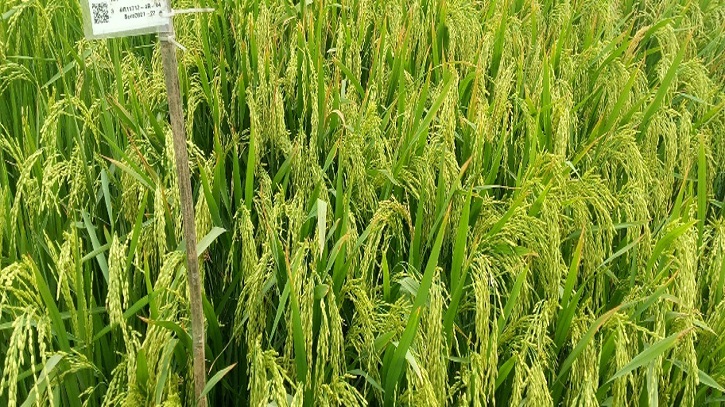
Bangladesh Rice Research Institute (BRRI) scientists have developed five new rice varieties that have already shown promising results in field trials. The varieties will be presented at a technical committee meeting next week before being submitted to the National Seed Board for approval. Once approved, the varieties will be released to farmers after completing necessary procedures, researchers said.
The new rice varieties include one enriched with Vitamin E, one tolerant to salinity, another resistant to cold stress, a high-yielding variety for the Boro season, and a strain resistant to bacterial blight.
Dr. Khondaker Md. Iftekharuddaula, Chief Scientific Officer and Head of BRRI’s Plant Breeding Division, confirmed that the varieties are awaiting approval. With these additions, BRRI’s total number of developed rice varieties will rise from 114 to 119.
Among the innovations is BRRI dhan-115, enriched with 15 ppm of Vitamin E. Researchers highlighted that Vitamin E works as an antioxidant, protecting cells from aging and damage, boosting the immune system, and helping to prevent cancer.
To combat bacterial blight—a devastating disease that discolors and scorches leaves and causes panicles to turn brown or white—BRRI developed BRRI dhan-116. This variety yields 9.1 tons per hectare, higher than the 8.15 tons per hectare produced by BRRI dhan-113.
Addressing the challenge of saline soils in Bangladesh’s southern region, scientists introduced BRRI dhan-117, a salt-tolerant strain capable of producing higher yields despite a shorter life cycle. This variety is expected to yield one ton more per hectare compared to existing types.
Recognizing the challenges of cold stress in Boro rice cultivation, particularly in haor wetlands, BRRI developed BRRI dhan-118. Low temperatures of 18 degrees Celsius for three to five days during flowering often lead to grain sterility in traditional varieties such as BRRI dhan-28 and dhan-29. The new cold-tolerant strain is designed to minimize such losses.
For areas where Boro rice is cultivated once a year, scientists created BRRI dhan-119, a long-duration variety with a 160-day life cycle that yields one ton more per hectare than BRRI dhan-81.
According to Dr. Iftekharuddaula, Boro rice accounts for 53 percent of Bangladesh’s total rice cultivation, with 20 percent concentrated in haor areas, where cold damage during seedling and flowering stages poses a major threat to production. The new varieties aim to mitigate such risks while improving productivity.
Professor Dr. Jasim Uddin of Sher-e-Bangla Agricultural University noted that Bangladesh currently produces over 40 million tons of rice annually, a major achievement for food security. However, he cautioned that climate change is creating new challenges, including extreme heat, irregular rainfall, cold spells, and emerging pests. He emphasized that the newly developed rice varieties will help farmers adapt by providing disease resistance and environmental tolerance.