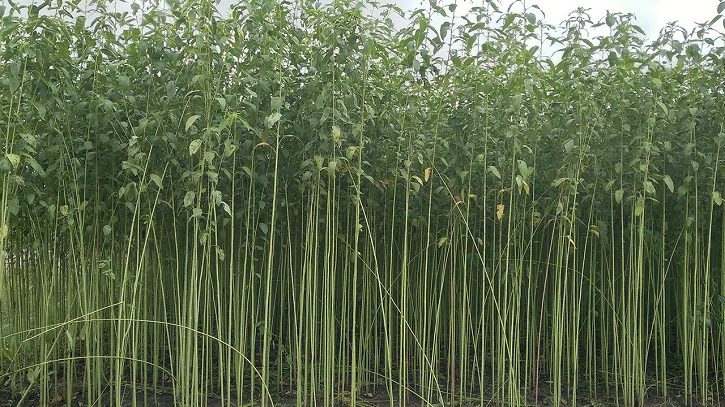
The Bangladesh Jute Research Institute (BJRI) has declared its newly developed variety, Tosha Jute-9—popularly referred to as ‘Sabuj Sona’ or ‘Green Gold’—as the finest jute variety in the country. This declaration was made at a regional workshop held on Sunday at the BRAC Learning Centre in the outskirts of Faridpur, following two consecutive cropping seasons of successful trial cultivation.
Dr. Md. Mojibur Rahman, Chief Scientific Officer of BJRI's Faridpur Regional Center, presented the keynote paper at the workshop titled “Introduction, Popularization, and Expansion of High-Yielding Jute and Allied Crops Developed by BJRI.” He explained that most of the Indian-origin jute varieties previously cultivated in Bangladesh were weak—some being intolerant to water, others requiring longer cultivation periods, and many producing inferior fiber despite their height. In contrast, the newly developed ‘Sabuj Sona’ overcomes these limitations.
Experimental cultivation across multiple test plots over the last two years showed that ‘Sabuj Sona’ grows taller than other varieties, with a shorter cultivation period of approximately 100 days—three to four weeks less than conventional jute varieties. It is also water-tolerant, making it more resilient in fields prone to waterlogging. Successful cultivation was recorded in five districts of the greater Faridpur region and at the BJRI station in Magura.
Farmers such as Akkas Ali from Magura and Moktar Molla, President of the Salta Jute Growers Association in Faridpur, presented field data highlighting the variety’s high yield and shorter cultivation time. Emphasizing the need to reduce dependency on imported jute seeds, speakers called on the Bangladesh Agricultural Development Corporation (BADC) to take proactive steps toward local seed production.
The event was presided over by Mohammad Khayer Uddin Molla, Additional Director of the Department of Agricultural Extension, Faridpur region. Moslem Uddin, Director of BJRI’s Technical Wing, attended as the chief guest. He noted that researchers across the institute unanimously agreed on the superior quality of ‘Sabuj Sona’ in all aspects.
Dr. Golam Mostafa, Chief Scientific Officer of the Breeding Division at BJRI, stated that the variety was developed through a single-session hybridization between India’s JRO-524 and a BJRI-developed line. Following rigorous evaluation and field-level success, the variety has now been formally recognized as the most advanced jute variety currently available in the country.
However, concerns remain regarding seed availability. Khayer Uddin Molla emphasized that without grassroots-level involvement in seed production, the widespread adoption of this improved variety may face delays despite its proven advantages.